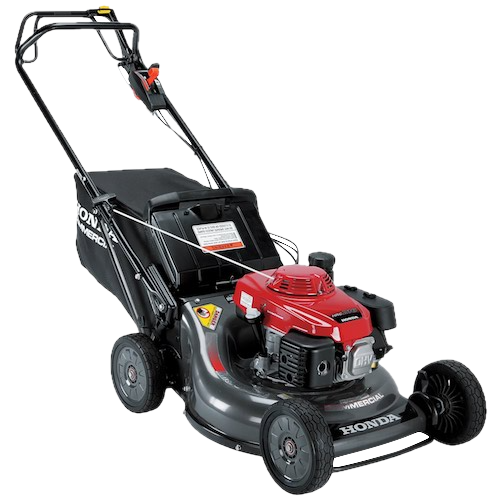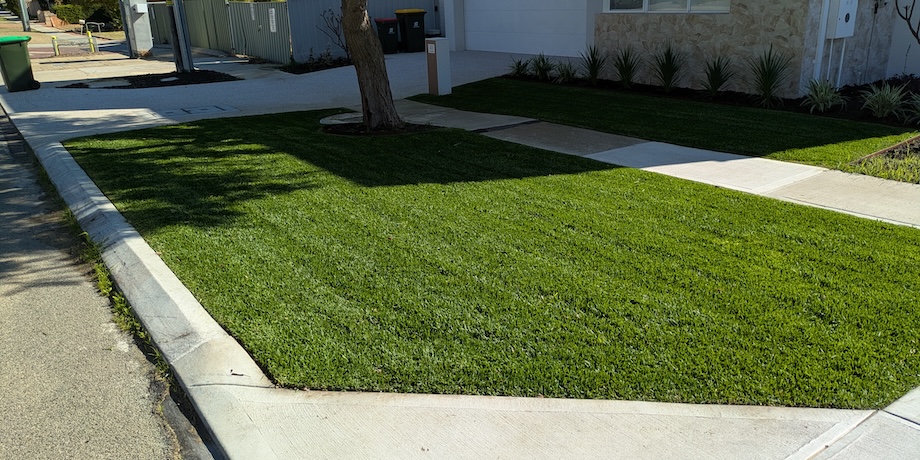
This professional lawn mowing guide will differ from the other practical articles on this topic, and will be a complete guide on the many different facets of mowing a lawn professionally with a rotary lawn mower.
The rotary lawn mower differs from the cylinder lawn mower in that the rotary mower sucks lawn clippings and debris into its grass catcher, whereas a cylinder mower has no sucking action at all but instead throws the grass it cuts, and anything else that goes through its blades, into the catcher at the front of the mower. Cylinder lawn mowing will not be directly addressed in this article as they have other factors and limitations to take into consideration when mowing lawns.
Once again, I am a lawn mowing contractor based in Perth, Western Australia, and these are the practices which work best for me, where I live, with the types of lawns we have here, and with what customers expect from their lawn mowing contractor in Perth. Some of what is written may not apply to other regions of Australia, and some things may be easily adapted.
Find The Water Meter
If this is a new job that is overgrown and if there is a possibility that the water meter could be hidden in long grass somewhere that I might be mowing, if I don’t know where it is, I will hunt for it and find it before any lawn mowing commences.
Blade Edging
In almost all cases I use the 3 wheel commercial blade edger first, to cut all lawn edges along hard edges like paving and footpaths and driveways, also along soft edges of garden beds.
If I am working on a new lawn mowing job which hasn’t been done for a while and is overgrown, and if I can’t ‘feel’ where the hard edges are when I move along with the blade edger, then I will need to use the line trimmer first, only in those places where I cannot perform a clean cut with a blade edger.
Once I’ve roughly cleaned up the problem edge with the line trimmer to give me a better indication of where the edge is between lawn and hard edge, then I will use the blade edger to give a proper edge cut.
Line Trimming
Next I will use the line trimmer to trim around all perimeters of the lawn, along hard edges and soft edges and fence lines, as well as trimming around obstacles in the lawn like trees and around any reticulated sprinklers that might be sitting proud.
Using the line trimmer around perimeters first allows us to more easily find and trim around any hidden water meters.
As I trim along soft edges of garden beds I might also run the line trimmer vertically along the same garden bed edges that I cut with the lawn edger to then give a more defined look to the edge, and a deeper cut. This gives a superior look to the soft edge and it can remove many lawn runners that are creeping into the garden beds from the lawn.
Sometimes hard edges don’t get a perfect cut with the blade edger, and they will need a quick zap with the line trimmer running vertically to cut any missed parts.
There might also be lawn runners creeping into paving and concrete pathways and driveways around the lawn edge, I will remove all of these overgrown runners with the line trimmer too.
For any lawn edges which are sitting proud, above the surrounding hard surfaces of paths and driveways, then I will not use the line trimmer on these edges at all, I will instead use the rotary lawn mower with 2 wheels on and 2 wheels off the lawn on the first pass, to give a perfect clean lawn edge, while saving time by not having to use the line trimmer on these edges at all.
If I want to do a ‘knock your socks off’ service for this customer, then as I’m using the line trimmer I might look out for any other weeds growing in hard surfaces or along fence lines immediately surrounding the lawn area, and I will spend 15 seconds to a minute or two trimming these weeds too. I can’t and don’t do this on every job, only when it is quick and easy to do and is immediately pertinent to the lawn mowing work I have been hired to do, and only when the job is properly priced.
There are some jobs where it is not necessary to use a line trimmer first, but trimming can be done with equal efficiency and cleanliness of the work by trimming after lawn mowing has been done. These instances will generally be when we are mowing very fine leafed lawns like Couch, and when the lawn is not at all overgrown, and when there is no leaf litter laying around the perimeters of the lawn.
Using The Leaf Blower
I then use the leaf blower to blow clean all hard surfaces like footpaths and paving and driveways and carports surrounding the lawn area before lawn mowing commences. This blows all mess that I made with the blade lawn edger and line trimmer back onto the lawn so that it gets sucked up by the rotary lawn mower.
This practice also blows clean all other debris that might be on those surrounding hard surfaces, like leaves and twigs and flowers falling from trees, and blows everything onto the lawn.
Before lawn mowing commences all hard surfaces are almost all spotlessly clean.
We might also have leaves and long clippings from weeds and lawn laying around the trunks of trees in the lawn and along fence lines too. If we do, then we blow clean around tree trunks in lawns and along fence lines, so that the rotary mower can pick up all of this debris so that we leave a perfect clean finish to our lawn mowing.
We blow clean at this time so that our finished job is of an above excellent standard.
There is an exception to this practice, when there are almost no leaves or mess or hard surfaces around the lawn, and if the line trimming and edging produced almost no debris at al. Obviously in these cases it is pointless to do the blowing at this time, we can just do blowing once when the job is completed.
Rotary Lawn Mowing
I use the rotary lawn mower to mow all perimeters around the lawn first.
The lawn mowing method will ultimately want to work the lawn mower up and down in straight lines along the longest part of the lawn. This means that at each narrow end of the lawn we need enough room to turn our lawn mower around.
If the narrow ends of the lawn where we want to make turns with the lawn mower have obstacles such as fences, cars, bushes, buildings, then we will not have enough room to turn our lawn mowers at these ends if we have only cut a single perimeter line with our lawn mower, therefore we may need to mow a double width line at the ends of the lawn where there are obstacles as just mentioned. We can then turn our lawn mowers around at these ends without missing any lawn with our mowers.
If we have flat surfaces on each narrow end of the lawn, such as a verge lawn that has a driveway at each end of the lawn, then we still want to do our perimeter lawn mowing first, as this allows the mower blades to go right up to the edge of the lawn for a superior mowing finish.
This time however, so long as the surrounding hard surfaces are clean and dry, we do not need to turn our lawn mower on the lawn itself, we can mow all the way to the end of the lawn and then off the lawn and onto the hard surface, and we then turn our lawn mower on the hard surface. This is only suitable when the lawn is not wet, and when the hard surface is clean and dry. This gives a superior looking finish to our lawn mowing.
If however the lawn is wet and the hard surfaces around the lawn are wet, then we can drag cut lawn clippings from off the lawn and onto the wet hard surfaces. Then as we turn our lawn mowers, lets say on concrete driveways, the lawn mower wheels which are covered in big globs of wet green grass are going to be dumped on the driveway to make an awful mess which might be impossible to blow clean. In such cases we will turn our lawn mower only on the grass and not on the concrete driveway, so that surrounding hard surfaces remain as clean as possible.
I always mow up and down in straight lines along the longest section of lawn.
Sometimes lawns have obstacles like trees and garden beds. In this case I will mow as I normally do in long straight lines until I get to the obstacle in the lawn, I then cut a perimeter around the obstacle with the lawn mower, by going around it in a circle.
For a single tree trunk sitting out of the lawn I just manoeuvre and go around it.
With a larger garden bed in the middle of a lawn I will continue to mow in straight lines and mow up to the large garden bed, then do a perimeter cut around the garden bed as described, and then turn the lawn mower around and mow back down again in another straight line. I will then do the same on the other side of the obstacle, so that all that is seen when I am finished mowing the lawn are nice perfect straight lines on either side of the obstacle going right up to it. The entire lawn remains as straight mowing lines.
Finishing With The Leaf Blower
All hard surfaces are then blown clean with the leaf blower, again. This time there should be nothing much more than a little dust and bits and pieces of a few lawn clippings from lawn mowing or that spilled when we emptied the catcher.
All of the heavy duty hard core lifting with the leaf blower that took the time was done on the first pass before we commenced lawn mowing, this time it should only take seconds.
This extra little step irrelevant for time reasons because the second blowing is so quick to do, and it is more than worth it to work this way because the finished quality of the work that we do is so far superior and leaves a beautifully clean and professional finish to our lawn mowing work and to our customers properties, and it leaves very happy and satisfied customers.
all articles and images are © copyright
thelawnmowingman.com