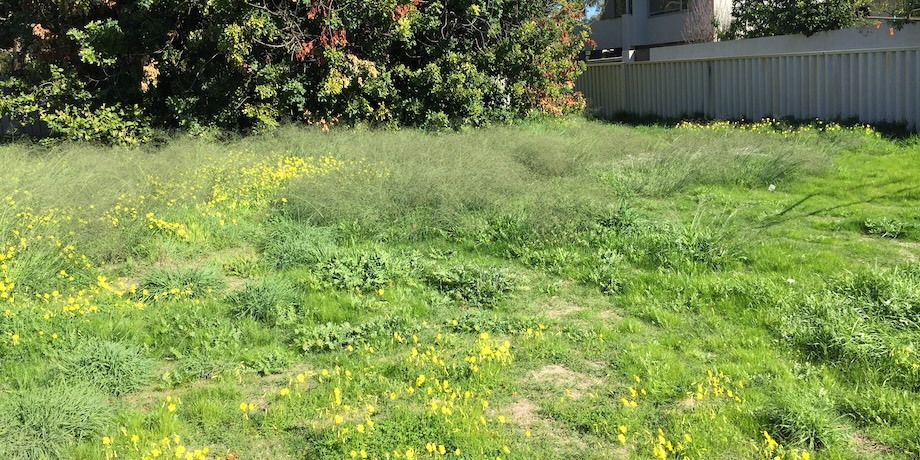
Slashing an overgrown block is always a big and dirty job to do, and every job is different from each other, so slightly different methods will be required from job to job. I’ll lay out here some of those methods, and the contractor should choose which methods are best suited for the requirements at hand, and which methods will ensure the best time efficiency and ease of work.
Find The Water Meter
The lawn mowing contractor should always locate the water meter on any overgrown block before commencing work. The water meter should be trimmed around first, and clearly marked with a large object on top of or next to the water meter.
Scout The Land
Next go across the land in up and down patterns while looking out for any foreign objects that we don’t want going through the lawn mower, you’ll be surprised at what can be found amongst a block full of overgrown grass and weeds.
Bricks, rocks, rubbish, carpets, household items, the list is unending, we should do our best to remove those items from out of the way before work commences.
Using The Line Trimmer First
This is generally the best thing to do, but not in every circumstance.
We would use the line trimmer to trim back around all fence lines, around trees and bushes, around garden beds, around any large objects, around pathways and driveways. This practice will also help us to discover many other hidden objects amongst long grass.
Then when we mow the lawn, all of that long cut grass that we just slashed with the line trimmer will go through the lawn mower and be chopped up nice and finely, leaving a nicer and more uniform finish to the work.
If we were to mow first and then cut the perimeters with a line trimmer, this would leave all of the lawn area looking mowed, with the long cut grass around the perimeters just laying around the edges, which would look really messy, and it would be clearly seen that this work was not done by a professional, but by someone who didn’t know how to do their work properly.
Having a more powerful and dedicated brush cutter for this work would be ideal, but it is generally not necessary for most city lawn mowing contractors, who might also find justifying this expense for a machine that might hardly ever be used, a tough ask.
When Not To Use The Line Trimmer First
It is always best practice to use the line trimmer first, and then to chop up the slashed grass in the lawn mower, so that the final work looks professionally done.
The same is true in this instance, however this time we are going to use a lawn mower to slash the perimeters, before we use the line trimmer to also slash the perimeters.
We would do this when there is really long and weedy and really hard to slash grass around the perimeters. In such cases we could find ourselves spending hours trying to use a line trimmer to slash the perimeters, which is of course wasted time, it would destroy us bodily, and it’s just bad work practice, and commonsense will show us the better way to do the work.
A more powerful brush cutter is another option, and might do well enough for some jobs, and for those lawn mowing contractors who own one. However there will still be cleanup jobs where another method of doing the slashing work is the better choice.
Those of us who only run battery line trimmers might want to be cautious with how we utilise our trimmers so as not to run out of juice. This method drastically cuts down on trimming time and so will make our battery trimmers last much longer.
After checking the perimeters, we use the lawn mower to cut the same perimeters we would with the line trimmer, going right up as close as we can to fences, paths, garden beds, and any other objects. The lawn mower is far more powerful and far more efficient and far easier to use in these circumstances, and the time taken to do this work will be drastically reduced, as will operator fatigue.
Once we’ve first roughly mowed the perimeters, we can then go around with the line trimmer to properly finish off the last remaining pieces of overgrown weedy grass.
Then to finish the work we would mow the block as we normally would have, and also we would get the exact same high quality finish, while saving a great deal of time, energy and fatigue.
Lawn Edging
Some overgrown blocks may be vacant lots, while others have houses which gardens and lawns have been neglected for one reason or another. In the case of houses, the owner might want lawn edging done as well.
In such a case, the best time to do that lawn edging might be when all the trimming work is completed, so we can more clearly see and define where the lawn edges need to go, whether along pathways and driveways or along garden beds.
Sometimes we may be able to do the lawn edges first on these cleanup jobs, depending upon the condition of those edges at each individual property, the lawn mowing contractor can best decide when the optimal time is to do the lawn edging.
Blowing Surrounding Areas Clean
Before commencing lawn mowing, all long and short grass and debris should be blown off roads, pathways, driveways, verandas, and all surrounding areas and back onto the grassed work area.
This way all of that grass will go through the lawn mower to be finely chopped up, which will leave a far superior and professional finish to the work we’re doing.
Mowing The Grass
How we mow overgrown blocks will depend on the condition of the block, how long the grass and weeds are, and how low we can reasonably go with lawn mowing dependant on property conditions.
We never want to catch the grass clippings when slashing overgrown blocks, we would never even go a metre without having to empty the catcher. Therefore the lawn mowing will need to be done without a catcher on the lawn mower, and also without a mulch plug.
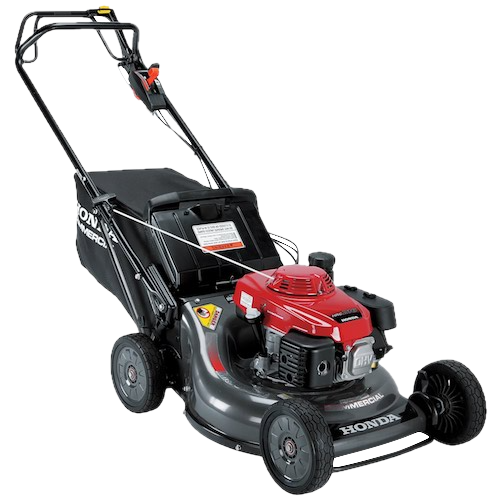
A dedicated slasher mower would be great in these circumstances, but for many of us who only ever see a job like this once every couple of years, it is not a worthwhile investment. In this circumstance we would use our strong commercial lawn mower for the work at hand.
Again, each job will be different, so we need to adjust methods as required.
We may be able to go across the entire property on the highest height of the lawn mower for our first quick and rough pass. After this we might be able to lower the cutting height, and then go over the area again, this time only mowing at half the width of the lawn mower deck. This might be enough to finish off the job to perfection.
The worst jobs may need a third pass over.
Some jobs may be fine with cutting twice at the highest cutting height of the lawn mower.
Some jobs that aren’t as bad might bring up a nice finish with a single pass over with the lawn mower at our desired final cutting height, though almost always this lawn mowing will need to once again be done at only one half the cutting width of the lawn mower.
When lawn mowing, we want all of the long grass we slashed with the line trimmer to go through the lawn mower blades to be finely chopped up to a consistent looking finish as the rest of the grassed area, so everything looks uniform and looks properly done.
Blowing The Work Area Clean
Of course we always want to finish every job by blowing all surrounding areas clean.
We should have done the first blow clean before lawn mowing was done.
In many cases this will mean that there is very little debris or cut grass left to blow clean back onto the grassed areas from surrounding areas.
In other cases, with the worst overgrown blocks there will still be yet another large mess to blow clean when the lawn mowing is completed, and so we blow the surrounding areas clean a second time. This time however we are not blowing long pieces of slashed grass back onto the finished mowed grassed area, but we are returning small chopped up pieces of grass back to look completely uniform as the rest of the mowed grassed area is.
all articles and images are © copyright
thelawnmowingman.com